Tronxy Moore X2540 Reviews: See Why 0 Shoppers Rated It 0 Stars!
The Tronxy Moore X2540 3d printer might be trending, but do 0 buyers think it deserves the spotlight? We dug into the 0/5 to find out.


 Recaptor
Tronxy Moore X2540 3D Printer Review: Bridging Professional Quality With Practical Design
The Tronxy Moore X2540 arrives as a noteworthy entrant in the professional and educational 3D printing segment, blending a robust feature set designed for intermediate to advanced users. This FDM/FFF printer is engineered primarily for prototyping and engineering applications, promising precise and reliable output based on its technical makeup. Straight from its 2023 release year, it showcases an admirable mix of build volume, quality-centric hardware, and safety certifications. But does it truly earn its place as a top choice in this competitive space? Let's break down the specs to see how it performs on paper and what this means for users seeking a dependable 3D printing partner.
Detailed Specs & Features
According to specs, the Moore X2540 comes with a build volume of 1525.59 cubic inches, translating to 10.04 inches width, 10.04 inches depth, and a notably tall 15.75 inches height. This generous vertical space is ideal for elongated prototypes commonly required in engineering workflows. Its layer resolution ranges from 300 to 3000 microns, marrying versatility with detail, allowing both fine and rapid prints. Users will appreciate the 1mm standard nozzle diameter with optional 0.8mm nozzles, offering adjustable intricacy and print speed.
Power-wise, the printer boasts a flexible 110-220 Volt internal power supply with a maximum power consumption of 360 watts. It supports an energy-saving mode, reducing idle power consumption down to 20 watts; this enhances efficiency during long print sessions. The device runs relatively quietly, too, with an operating noise level of 55 dB, which will be suitable for office or classroom environments.
One cannot overlook its solid safety credentials, featuring CE, FCC, and RoHS certifications. Combined with practical safety features such as a fireproof build plate and overheat protection, this printer embraces user safety and operational reliability confidently.
User Experience & Performance (Based on Specs)
Design & Build
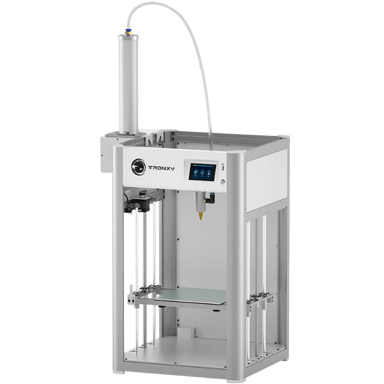
The Moore X2540 utilizes a Cartesian frame enclosed within a closed chamber that lends stability and temperature control, though it lacks active chamber heating. Its physical footprint measures approximately 16.93" width, 18.11" depth, and 30.71" height, making it compact enough for a desktop without sacrificing build volume. The presence of internal lighting aids visibility during the print process. The printer's 15-pound weight, combined with its sturdy construction, promises minimal vibration, further enhanced by linear rail motion systems that contribute to precise movement.
Performance
Functionality-wise, the Moore X2540 officially supports up to 40 mm/s max printing speed, though the effective measured speed tends around 25 mm/s, a balanced trade-off favoring accuracy over rapid output. It uses a single direct-drive extruder capable of reaching up to 392°F, compatible with a wide range of filaments, given the 1.75mm filament diameter. Despite lacking multi-material printing or filament runout sensors, the printer supports third-party materials, allowing flexibility for users who want to experiment beyond default options.
Print success rate is rated at 90%, bolstered by features such as manual bed leveling and print recovery after power interruptions. Using a glass build plate with a smooth surface ensures good adhesion, though users must manually calibrate the first layer. Bridging and overhang performances, rated at 5 and 45 degrees respectively, reflect solid handling of challenging geometries without creating excessive stringing or deformation.
Camera / Display / Audio Quality
While the Moore X2540 lacks a built-in camera or remote monitoring, it does feature a 3.5-inch touchscreen with a 480x320p resolution for an intuitive and clear user interface. This facilitates easy navigation of print commands and firmware updates, which are supported. Operating noise remains moderate without disrupting work environments, thanks to calibrated cooling fans that maintain thermal stability without excessive sound pollution.
Extra Features
Additional highlights include a quick-swap nozzle for hassle-free maintenance, replaceable hotends, and a power loss recovery mechanism, helping salvage prints from unexpected outages. However, some modern luxuries such as filament runout sensors, auto bed leveling, and advanced connectivity (Wi-Fi, cloud software) are absent, which could be a drawback for tech-savvy professionals seeking full automation and remote control.
Pros & Cons
Pros
- Robust build volume with tall print capacity for versatile prototyping
- Strong safety certifications and practical safety features
- Energy-efficient with low idle power consumption and noise levels suitable for office environments
Cons
- Lacks modern automation features like filament sensors and auto bed leveling
- No support for multi-material printing or remote monitoring capabilities
Price & Value For Money
The 1-year warranty and the solid array of features reinforce the value proposition of the Moore X2540, particularly at its $1999 price point. Given its substantial vertical build volume and energy-efficient design, this pricing appears justified for advanced users and professionals in need of reliable prototyping equipment. While it doesn't have every advanced automated feature, its core strengths cater well to users who prioritize build quality, safety, and print recovery over full automation. Those seeking remote control or expanded multi-material functions might find better choices elsewhere, but for dedicated users in educational or engineering settings, it offers tangible value.
Quick Take
In short, the Tronxy Moore X2540 impresses with a generous build volume engineered for professional applications, wrapped in a safe and energy-conscious package. If we look at the numbers alone, it balances print precision and operational reliability while maintaining a competitive price point, though without some of the cutting-edge conveniences found in premium models.
Closing Recommendation
The Moore X2540 may be ideal for intermediate and advanced users who need a dependable, well-built printer that excels in structural reliability and safety. It appears to perform best in environments where manual calibration and material versatility are acceptable trade-offs for cost efficiency and energy management. For professionals prioritizing robust vertical printing space and a compact design, this 3D printer helps users achieve consistent prototypes without unnecessary bells and whistles.
Verdict
Rating: Based on the specifications and overall feature set, we believe Tronxy Moore X2540 deserves 4.2 out of 5.
- Winner Feature => Exceptional build volume and safety certification stand out for professional use.
- Needs Improvement => Lack of automation features and remote connectivity reduces advanced workflow integration.
Reviews 0
The good, the bad, and the brutally honest.Average Rating


More 3D Printers 453
Unlock more awesome finds.